Events
HLTH USA in Las Vegas: meet 2care's AI workforce
2care is at HLTH USA in Las Vegas, Nov 15 to 18. See the front and back office work an AI workforce does for clinics. Book a meeting with Pawan.
Key takeaways
- Co-founder Pawan Toshniwal will be at HLTH USA in Las Vegas from November 15 to 18, and leaders of groups and health centers can meet him there.
- 2care handles booking, insurance checks, prior authorization, care-gap calls and referral intake in one platform, across the front desk and the back office of every site.
- Each booking is written into the practice's own EHR or practice management system during the call, and 2care connects to 95+ of them, so staff rekey nothing.
- Emergency and clinical calls reach a human or a nurse or provider queue within seconds, with the transcript attached.
- MGMA's February 2026 poll of 177 practice leaders ranked scheduling (31%) and calls (27%) as the front-office areas where they most want AI help.
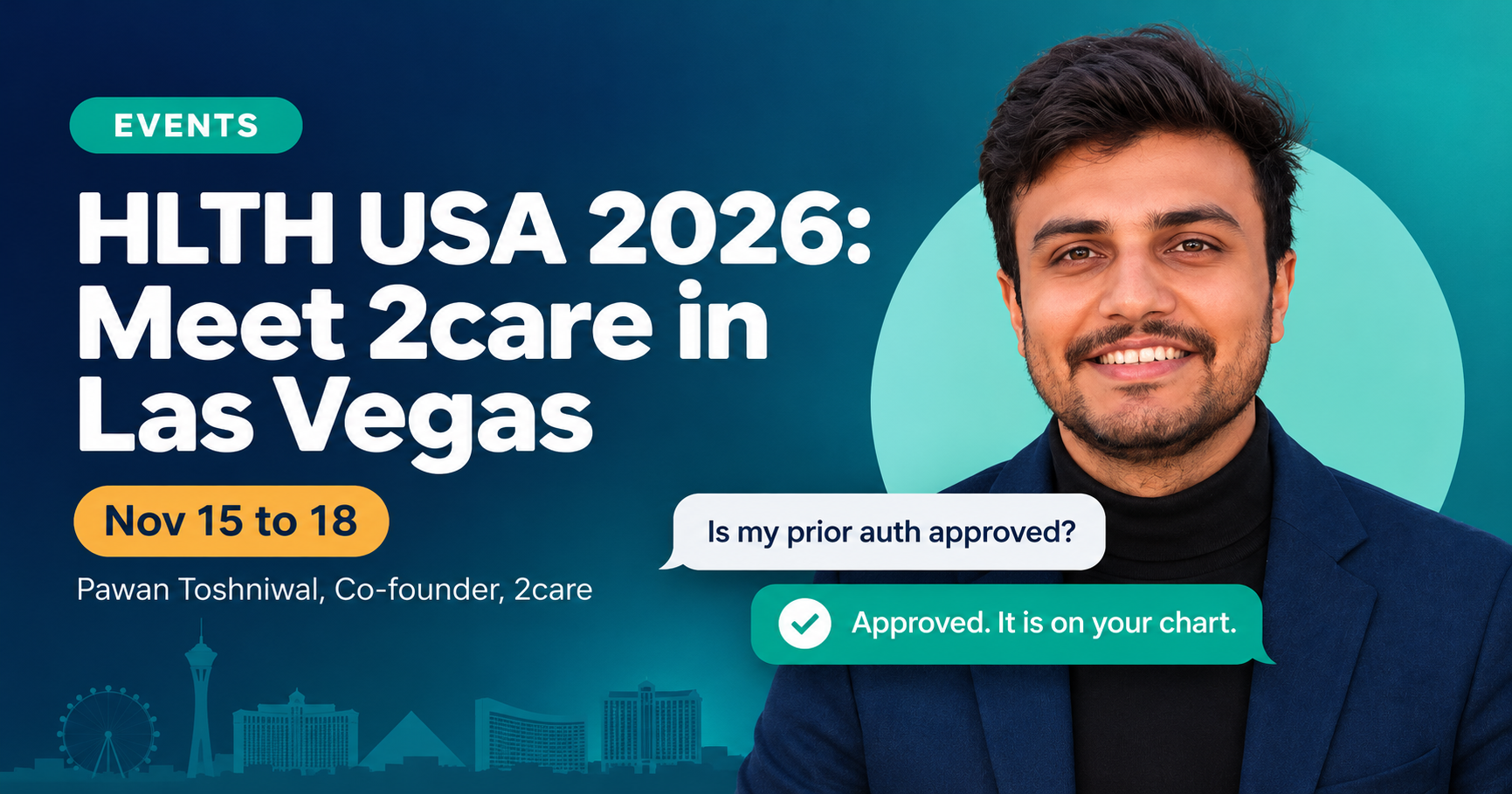
Co-founder Pawan Toshniwal will be at HLTH USA from November 15 to 18. Here are the problems we work on for groups and health centers.
2care is an AI workforce for the front and back office of clinics. It answers calls, books into the live schedule, checks insurance and prior authorization, calls patients with open care gaps and reads faxed referrals. Co-founder Pawan Toshniwal will attend HLTH USA in Las Vegas from November 15 to 18.
A group with twelve sites has twelve front desks, and each one handles the same few calls in its own way. At a health center the same calls reach a smaller team, which also holds a list of overdue patients and a stack of payer faxes to read.
That is the work 2care does. It answers practice calls at any hour, books into the live schedule, checks coverage and prior authorization before the visit, calls patients who are overdue for care and reads faxed referrals. It runs inside the systems a practice already uses, so staff are not asked to learn a new one or change how they chart.
Pawan will be at HLTH USA at The Venetian in Las Vegas. Owners, operations leaders and administrators of groups, DSOs, health centers and independent practices are welcome to ask him how each job below works on a real schedule, or to book a meeting with him before they travel.
| Practices | Integrations | Missed calls recovered | Time to go live |
|---|---|---|---|
| 120+ practices use 2care | 95+ integrations with two-way write-back | About 85%, across the practices 2care works with | About two weeks |
2care's own figures, October 2026.
Where groups and health centers lose visits at the front desk
Every site in a group answers the same four kinds of call: questions with fixed answers, requests to book, refill messages that land on the booking line, and patients asking about coverage. Each call pulls someone away from the person standing at the counter, and the load is uneven. One site's phone rings out at nine while the next site's is quiet.
Practice leaders already point AI at this work. In a February 2026 MGMA Stat poll with 177 responses, scheduling (31%) and calls (27%) were the front-office areas named most often, followed by registration and eligibility (23%) and prior authorization (16%).
The same MGMA write-up cites a July 2025 poll in which 71% of practices said fewer than a quarter of their patients use digital tools to self-schedule. For those patients the phone is still how they book.
Booking rules add a second layer. Providers, visit types and durations differ from site to site, so a booking is a matching problem as well as a conversation.
What 2care does on the call
2care answers on the first ring and works through the call the way a trained front desk would. It reads live openings by provider, appointment type, location and duration, holds a slot that is free, and writes the appointment into the EHR or practice management system before the call ends. A returning patient is matched to the chart that already exists, so nobody ends up with a duplicate record.
When a call needs a person, it moves fast. An emergency reaches a human within seconds, and a clinical question reaches a nurse or provider queue just as fast. The staff member receives the transcript and a summary with the transfer, so the patient does not repeat the story. A refill request is captured with the medication and pharmacy and sent to the right provider queue. Approving it stays with the provider.
The same two-way write-back runs across 95+ systems on the 2care platform.
Insurance, prior authorization and claims
Coverage problems are cheapest to fix before the visit. On the booking call, 2care collects the payer and member ID, reads both back, checks that the plan is active for the visit date and records the copay and deductible the plan reports. A lapsed or switched plan is flagged while the patient can still act. The detail is on the insurance verification page.
Prior authorization is where the back office spends the most time on fax and phone. 2care checks whether a planned service needs it, files the request through whichever channel the payer accepts, follows it to a decision and writes the auth number, units and valid dates to the chart. Where the payer's answer is unclear, the answer stays open for staff instead of being guessed.
The manual version is costly. The 2025 CAQH Index, built on data from more than 600 provider organizations and health plans, estimates another $21 billion in savings if the remaining manual and partly manual transactions became fully electronic. Claims follow-up sits at the end of the same chain, and the platform page now describes insurance, prior authorization, referrals, claims and denials as one admin workforce working inside your own systems.
Care gaps and referrals that wait for someone's time
Two lists wait for a free hour: patients overdue for a chronic-care review, a screening or a follow-up, and referrals that arrived by fax.
For care gaps, 2care takes the list from your records, calls each patient, books the visit on the same call and closes the gap on record, with the outcome logged. Reminders go out before each visit, recall and reactivation work lapsed patients, and a cancellation can trigger waitlist offers so the slot is refilled. More on how the calling rules work is on the care gap outreach page.
For referrals, 2care labels the pages of a fax, reads the fields, creates or matches the patient record, checks eligibility and files prior authorization where it is needed. It then calls the patient to screen and book, and sends the referrer a fax and the patient a text. Each step can run alone or wait for staff approval.
What changes at the desk, side by side
The table follows seven jobs from the way they run today to a day with 2care, ending with what happens when the answer is unclear.
| Today | With 2care | Where you see it |
|---|---|---|
| Each site answers the same questions all day | Answered on the call at any hour | Call transcript and summary on file |
| Booking rules live in a manual or a manager's memory | Rules mapped in setup, then checked by the EHR as each booking is written | Visits on the schedule at the right site and length |
| After-hours calls go to voicemail | Answered and booked into the next opening | A booked visit waiting in the morning |
| Coverage is checked on the day, if at all | Checked before the visit | Plan status, copay and deductible on the chart |
| Prior authorization is chased by fax and phone | Filed through the channel the payer accepts and followed to a decision | Auth number, units and dates on the chart |
| Overdue patients and faxed referrals wait for a free hour | Called, screened and booked | New visits on the schedule, outcome logged |
| When the answer is unclear | A prior authorization answer stays Unknown or Depends, and a fax field read with low confidence is held back | A task for your staff instead of a guess |
What one workforce changes for a twelve-site group
A group with twelve sites can end up with twelve front desks, each with its own habits. Our customer story about a twelve-site dental group describes that pattern, and how one agent gave each location an answered line and a shared diary.
The mechanism carries over to other sites. When 2care books, it respects each location's providers, appointment types and durations, so a caller for the north site is offered the north site's openings. For a DSO, a health center network or a physician group, that is one way of handling calls across sites without hiring the same role twelve times.
It also gives an operations lead one place to look. Every action is logged in the same format, so call handling at one location can be read beside call handling at the next.
How your own staff can check the work
Each action 2care takes is logged with its evidence beside it: the payer's response, the fax page or the call recording. You set which steps run by themselves and which stop for a person, and a step set to wait sends nothing to a payer or a patient until someone approves it.
Clinical calls go to your team. Chest pain, stroke signs and severe bleeding are treated as red flags and handed off. Triage and advice stay with your clinicians.
US practices can sign a Business Associate Agreement. Data is encrypted in transit and at rest, and patient data is not used to train shared models.
What the first two weeks look like
Going live takes about two weeks, by 2care's own figure. Your administrator approves the connection to your EHR or practice management system, then we map your providers, locations, visit types, booking rules and escalation paths so the agent follows your schedule.
Before the line switches over, we run your real call scenarios in a test environment while your team listens. The number patients dial stays the same, because 2care sits in front of the phone system you already have.
Which organizations this suits
Four kinds of organization get the most from this conversation:
- A multi-location group or DSO that wants one set of call and booking rules at every site.
- A health center or network where staffing pressure lands on scheduling, eligibility and billing follow-up, with a long list of patients overdue for care.
- An independent primary care or dental practice with more than one provider and a phone that rings out at peak hours.
- A specialty group or physician network standardizing front and back office work across member practices.
Two limits apply. Clinical judgment stays with your staff: medical necessity, peer to peer reviews, appeals strategy and any prior authorization answered Depends or Unknown. And booking follows the rules in your EHR, so unstable appointment types or durations are worth fixing first, because MGMA warns that automation can scale up inconsistency.
Frequently asked questions
How does 2care decide whether a service needs prior authorization?
2care reads three things: the authorization flag in the payer's eligibility reply, the payer's verified policy document and any free text the payer returns. A single yes from any of them makes the answer required. Staff can open the policy line and page number behind each answer and check it in seconds.
What happens when a payer faxes back an authorization decision?
2care reads the faxed letter and sorts it into approved, denied or needs info, then puts the auth number, units and valid dates on the chart. The original page stays attached. A field it cannot read with confidence goes to staff for review instead of being guessed.
How does 2care reach payers that do not take electronic requests?
It uses whichever channel each payer accepts: fax, payer portal, an electronic request where the payer takes one, or a phone call. For phone-only payers the call is placed for you, and the rep name and reference number are logged with the request.
Do I need to be in Las Vegas to see 2care?
No. If you will not be in Las Vegas, you can book a virtual call with Pawan Toshniwal instead. Pawan will be at the event from November 15 to 18 for people who prefer to meet in person.
A comparison to make before you travel
Pick the two sites in your group that run most differently. At each one, write down the five rules that decide a booking: who can take new patients, which visit types need longer slots, which times are held back. If the two lists disagree, settle that first, whether or not you ever use 2care. Bring both lists to your meeting with Pawan and we will test them on real calls.
Talk through your own call flows and admin list with Pawan. Book a meeting with Pawan, in person at HLTH USA or as a virtual call.
More stories
All posts
Get every new post by email
Notes from the front desk, sent as they publish - every Tuesday and Friday. No filler.
I agree to receive the 2Care AI newsletter. Unsubscribe anytime.