
What dental-medical referrals should mean for patients
HLTH 2026 spotlights dental-medical referrals and AI dental imaging. See what it takes for a referral to reach a kept appointment.
Key takeaways
- 2Care.ai's AI phone agent already answers calls for dental and medical practices alike, the same two sides HLTH's pavilion is trying to connect in its sessions.
- CDC guidance already models the two-way relationship HLTH is discussing: dental teams screen for diabetes risk, medical teams ask about oral health at every visit.
- A 2023 Evidence-Based Dentistry review of 16 systematic reviews found periodontal therapy lowered HbA1c by 0.49 points at three months, not significant by six.
- Avora Dental, a dental practice, 2Care.ai's phone agent booked 68 after-hours inquiries in its first month that would otherwise have gone to voicemail.
- The practical test for any oral-systemic claim at HLTH is simple: name the study, the outcome measured, and whether the intervention changed that outcome.
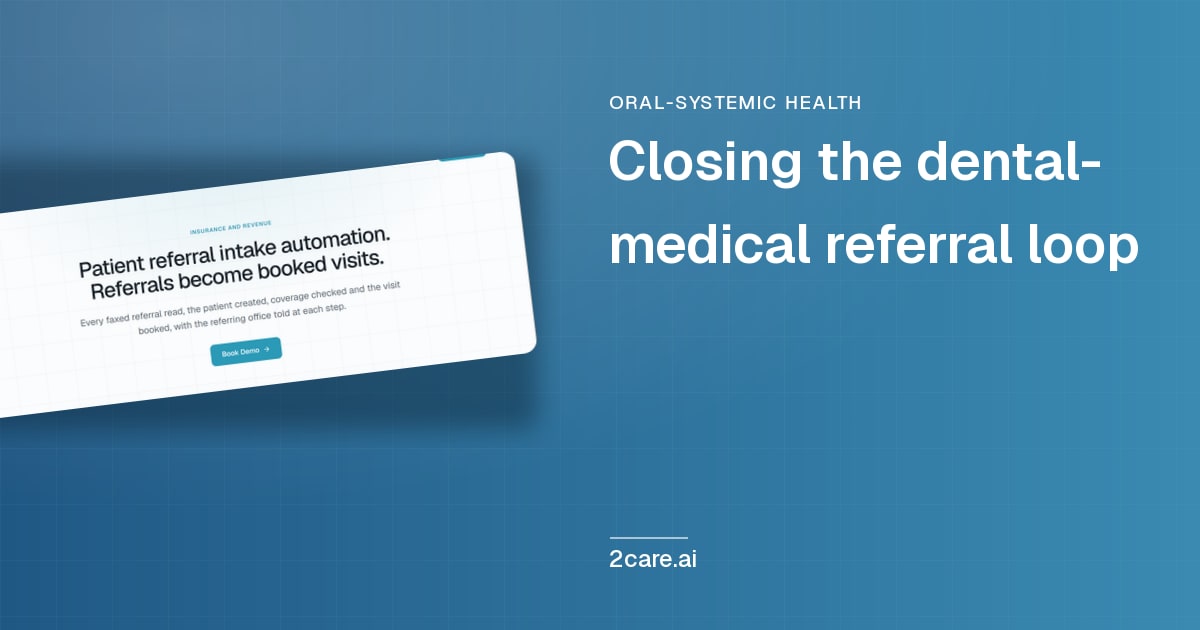
HLTH 2026's oral-health pavilion raises the right questions about screening, AI, and referrals. The harder part is building a loop that actually closes.
HLTH 2026's Oral & Systemic Health Pavilion brings dental screening, AI imaging, and data sharing into one track, but none of that helps a patient unless a result becomes an action. A screening finding should lead to a named clinician, a tracked referral, and a visit that actually happens, not just another number on a chart.
A patient sits down for a free screening at a health fair. A technician checks blood pressure, pricks a finger for an A1C reading, swabs the mouth for a saliva test. Twenty minutes later three numbers come back, and nobody at the table is responsible for what happens to any of them.
That is the version of connecting oral and medical care that already exists at most events: screening as its own finish line. HLTH USA 2026's Oral & Systemic Health Pavilion, running November 15 to 18 in Las Vegas, is trying to build something past that. Its sessions put dental-medical integration next to AI-powered imaging, dental data sharing, and the Medicaid coverage and access questions that decide whether any of it reaches a patient outside the pavilion.
The program itself is the easy part. Four questions decide whether a patient leaves HLTH's agenda better off than the health-fair version: who explains a result, who decides if it needs a referral, who confirms the visit happened, and what evidence actually backs the connection being described on stage.
A screening result needs a name attached, not just a number
HLTH's pavilion page describes onsite screening that includes A1C, saliva, and blood-pressure checks. That is a concrete, useful example of bringing oral and general health into the same room. It is also where most screening programs quietly stop.
A result that needs attention raises three questions before it raises any clinical one: who explains what it means, who decides whether the patient needs a further workup, and who checks that the handoff to that next clinician actually happened. A screening encounter is not a diagnosis, and treating it as one, even implicitly, by handing someone a printout and a smile, leaves the clinical value of the test on the table.
CDC guidance already describes the two-way version of this relationship: dental professionals can screen patients at risk of diabetes and refer them to primary care for diagnosis, while medical teams are encouraged to ask patients with diabetes about their oral health at every visit and recommend a dental exam at least once a year. That is a workable model, not a pavilion aspiration. The open question for HLTH is whether any exhibitor's tooling actually operationalizes it, or whether the referral still ends at a business card.
Oral-systemic links need evidence, not a bigger promise
The pavilion names oral health's links to diabetes, cardiovascular disease, and cognitive health in the same breath. Those three claims do not carry the same weight, and treating them as equally settled is where a credible session turns into a marketing one.
Diabetes is the clearest case. People with diabetes carry a higher risk of periodontal disease, and poor glucose control can make oral problems more likely while interfering with healing; gum disease, in turn, can make glucose harder to control. A 2023 review in Evidence-Based Dentistry pooled 16 systematic reviews covering 30 meta-analyses and found nonsurgical periodontal therapy reduced HbA1c by 0.49 percentage points at three months (p = 0.0041) compared with no treatment. By six months the reduction narrowed to 0.38 points and was no longer statistically significant (p = 0.0851).
That is real evidence for one intervention, strongest in the short term and already weaker by six months, in people who already have both diabetes and periodontitis. It is not a guaranteed result for any individual patient, and it does not mean a cleaning replaces insulin management. The American Dental Association makes the broader point explicitly: an association between periodontal disease and cardiovascular disease does not establish that treating gum disease prevents a heart attack. For any oral-systemic claim made from a stage, the useful questions are which study backs it, what outcome was actually measured, and whether the intervention changed that outcome.
An AI imaging demo should end in a clinical question
AI-powered dental imaging and diagnostics, alongside AI governance, are named tracks at HLTH's pavilion. A live demo that flags a cavity or a bone-loss pattern is genuinely impressive to watch. It is also the easiest kind of claim to oversell, because "the software found something" and "the patient is better off" are two different outcomes, and only one of them is visible on a trade-show floor.
The right questions to bring to a demo booth are about deployment, not detection: what is the tool's intended use, which patients were in its evaluation set, how are false positives and missed findings handled downstream, and does the output actually change a clinician's decision or just add one more result someone has to review. None of that is a knock on any specific exhibitor. It is the difference between a useful image output and a better patient outcome, and HLTH's program is exactly the place to ask exhibitors to show which one they have evidence for.
Data sharing only works if someone tracks the follow-through
HLTH's oral-health track also covers EHR integration, dental data sharing, Medicaid dental coverage, and access gaps, which pushes the conversation past diagnosis and into logistics. A clinical recommendation is far easier to act on when the clinician receiving it understands the concern, the relevant history, and the specific question being asked. It also has to be feasible for the patient: is there an open appointment, can they afford the visit, and does anyone step in if the referral stalls before it reaches a calendar.
A workable standard is simple to state and hard to run without software: agree on what information gets sent, what response is expected, and who is responsible for reviewing it, then track whether the assessment actually happened rather than counting a referral sent as care delivered. That distinction, a referral sent versus a visit completed, is where most of the "we connect oral and medical health" claims at a conference quietly fall apart once the booth closes.
What this means for the practices on both ends of the referral
Every one of the four questions above lands on the same desk: whoever answers the phone, runs the appointment scheduling, and follows up when a patient does not call back. For a dental practice referring a patient to an endocrinologist, or a primary care office recommending a long-overdue dental exam, that handoff is operational before it is clinical. The pavilion's sessions assume a system exists to carry a finding from a chairside screening to a kept appointment. Most small and mid-sized practices do not have one; they have a sticky note and a front-desk staffer managing two phone lines during lunch.
Where the referral loop actually breaks
| Step | What should happen | Usually responsible | Where it breaks down |
|---|---|---|---|
| Finding | A screening result (A1C, saliva marker, imaging flag) gets a plain-language explanation | Whoever ran the screening | Patient leaves with a number and no context |
| Decision | Someone decides whether the finding needs a referral versus routine follow-up | A clinician, not a technician | No one is assigned to make the call |
| Handoff | The receiving clinician gets the finding, the relevant history, and the specific question being asked | Front desk or care coordinator | A verbal "you should see someone" with no record sent |
| Appointment | The patient actually gets booked, with cost and timing addressed | Scheduling staff | Patient is told to call a number themselves and never does |
| Completion | Someone confirms the visit happened and the loop is closed | Whoever owns the original referral | The chart shows "referred" and nothing after it |
Where an AI front desk fits into that loop
This is the part of HLTH's agenda that has nothing to do with imaging or evidence, and everything to do with whether a practice can run the loop above without adding headcount. At Avora Dental of Altamont, after-hours and weekend calls were going to voicemail, and most callers never left one; hygiene recall outreach happened only when staff had spare time. 2Care.ai's AI phone agent started answering on the practice's existing number and booked 68 after-hours inquiries in its first month, inquiries that would otherwise have been lost before anyone decided whether they needed a referral at all. The same logging that caught those calls is what lets a practice check whether a referral mentioned mid-visit ever turned into a kept appointment, instead of relying on staff memory.
Where this fits a practice's referral loop
An AI front desk is the right piece of infrastructure for a practice when three things are true: the practice already refers patients across a dental-medical line often enough that tracking it by memory is unreliable, the practice has the staff bandwidth to decide on referrals but not to chase down whether they were kept, and the practice wants a record of every call, not just the ones a staffer remembers to write down. It fits a solo dental practice running diabetes screenings just as well as a primary care practice that wants to confirm its patients are seeing a dentist annually, because the underlying problem in both cases is the same: a decision made in the room has to survive the walk to the parking lot.
Frequently asked questions
Does a positive screening result at a health fair count as a diagnosis?
No. A screening check, such as an A1C or blood-pressure reading taken at an event, flags a risk that needs follow-up. It is not a diagnosis, and it should come with a clear next step: who to see, and by when, rather than just a number on a printout.
Can a dentist actually refer a patient for a diabetes workup?
Yes. CDC guidance supports dental professionals screening at-risk patients and referring them to primary care for diagnosis, and recommends medical teams ask about oral health at every visit in return. The referral still has to reach a kept appointment to matter.
Does treating gum disease prevent heart disease?
No. The American Dental Association is explicit that an association between periodontal disease and cardiovascular disease does not prove that treating gum disease prevents a heart attack. Evidence for a causal, treatable link is strongest for diabetes, not for cardiovascular disease.
What should a practice ask an AI dental-imaging vendor at HLTH?
Ask what the tool's intended use is, which patients were included in its evaluation, how it handles false positives and missed findings, and whether its output has been shown to change a clinical decision, not just produce a flagged image.
How does an AI phone agent help with oral-systemic referrals specifically?
It gives a practice a record of every call, including the ones where a referral was mentioned, so staff can check whether a booked follow-up ever happened instead of relying on memory. It does not replace the clinical decision about whether a referral is needed.
A practical next step
Before HLTH 2026, pick one referral pattern your practice already handles informally, such as sending diabetic patients for a dental exam or flagging periodontal patients for a medical check, and write down who is responsible for each of the five steps in the table above. Most practices find the gap is not the clinical judgment; it is the step after it, where nobody owns confirming the appointment happened. That gap is worth finding before a vendor's dashboard finds it for you.
If you want to see how an AI phone agent logs and tracks that kind of referral in practice, book a short walkthrough with 2Care.ai and bring your own example instead of a hypothetical one.
More stories
All posts
Get every new post by email
Notes from the front desk, sent as they publish - every Tuesday and Friday. No filler.
I agree to receive the 2Care AI newsletter. Unsubscribe anytime.