2care.ai vs Confido Health for Primary Care Practices
Choosing an AI front desk for primary care? See how 2care.ai and Confido Health compare on EHR fit, languages and urgent calls.
Key takeaways
- 2care.ai connects to 95 EHR, PMS and HIS platforms, so your practice keeps the system it already runs instead of rebuilding its schedule around a phone tool.
- Patients reach 2care.ai by voice, SMS and WhatsApp in 50+ languages, which suits primary care waiting rooms where one practice serves many communities.
- When a caller describes something clinical, 2care.ai passes the call to a person on your team with the transcript attached, so the patient never repeats the story.
- Go-live takes about 5 business days, so missed calls can stop within the same week the decision is made, not the same quarter.
- Confido Health lists 11 integration logos, 20+ languages and a go-live time under 30 days, so the tools differ on system reach, languages and speed.
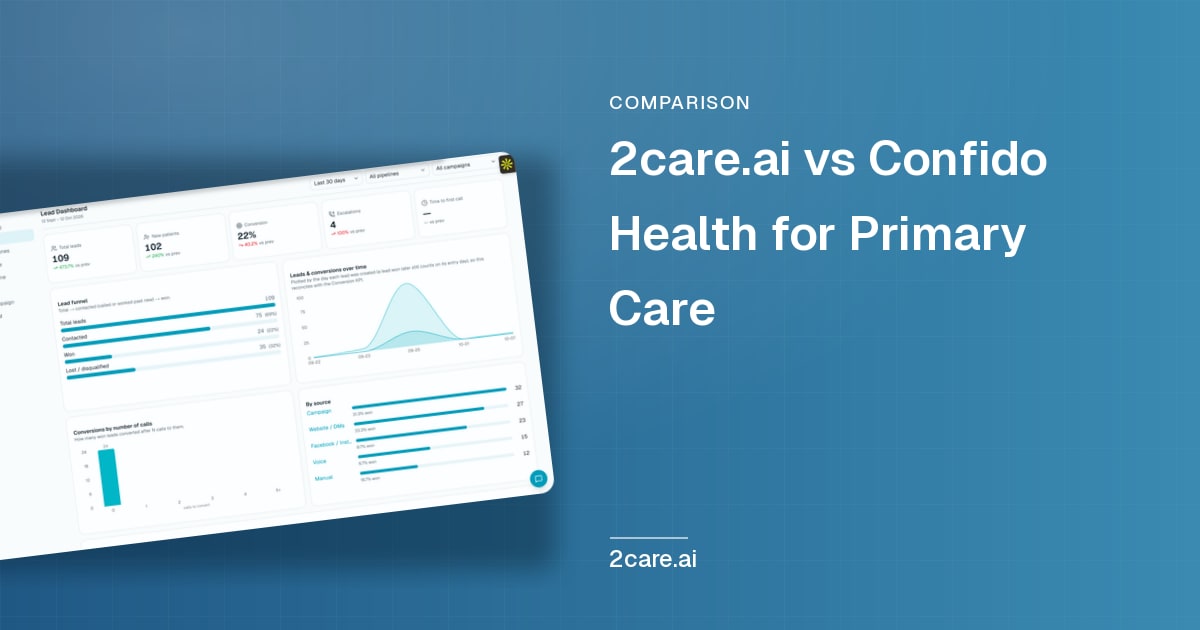
2care.ai and Confido Health both use AI to answer patient calls and book appointments. For a primary care practice, the difference is fit. 2care.ai connects to 95 EHR, PMS and HIS platforms, answers in 50+ languages, reaches patients by voice, SMS and WhatsApp, and goes live in about 5 business days.
At 12:20 on a Wednesday, the front desk is checking in a patient with a toddler on her hip while the phone lights up for the third time in five minutes. A woman wants a refill appointment. A man wants to know if the practice takes his new insurance. A daughter is calling on behalf of her father, and she would rather text in Spanish than wait on hold. Nobody picks up. Two of the three call the next clinic on the list.
Primary care carries a wide mix of callers: annual physicals, chronic care follow-ups, referrals, children, parents, and older patients who are not comfortable with a portal. The phone is where all of that arrives at once.
An AI front desk answers every one of those calls and books the visit. Confido Health and 2care.ai both do that. This page compares the two on the things a practice owner or manager actually feels: which systems they connect to, who they can talk to, how patients reach them, what happens on an urgent call, and how quickly they go live.
A MGMA Stat poll of 236 practice leaders, run on December 9, 2025, asked what their top patient access focus would be for 2026. Phone access was named by 22 percent, behind no-shows at 27 percent and online scheduling at 24 percent, and just ahead of wait times at 21 percent.
The reason is simple. The front desk handles check-in, check-out, insurance questions and the phone at the same time. When the room is full, the phone loses.
What Confido Health offers a primary care practice
Confido Health describes itself as an AI-powered healthcare communication and workflow automation platform. Its agents, named Sara, Ryan and Lilly, handle scheduling, payment collection, pre and post operative engagement, and care gap closure. They work over voice, text and voicemail, in 20+ languages.
Confido works with specialty practices in nephrology, orthopedics, dermatology, pain medicine and pediatrics, among others. Its site shows 11 integration logos, including eClinicalWorks, athenahealth, ModMed and DrChrono, and states a go-live time of under 30 days.
What 2care.ai offers a primary care practice
2care.ai is an AI front desk for healthcare. It answers every call, books the patient into the schedule your team already uses, sends reminders, and follows up after the visit. Primary care is a named specialty, alongside dental, orthopedics, women's health and more.
The product is built around one idea: the practice should not have to change anything it already depends on. The EHR stays the source of truth. The phone number stays the same. Clinical calls still reach a person.
How do 2care.ai and Confido Health compare?
Both tools answer patient calls and book appointments. They differ on how many systems they connect to, how many languages they cover, which channels patients can use, how an urgent call is handled and how fast a practice goes live. The table below lines those up for a primary care practice.
| 2care.ai | Confido Health | |
|---|---|---|
| Systems connected | 95 EHR, PMS and HIS platforms | 11 integration logos on its site |
| Languages | 50+ | 20+ |
| How patients reach it | Voice, SMS and WhatsApp | Voice, text and voicemail |
| Urgent or clinical calls | Sent to a person on your team with the transcript attached | Forwarded to the relevant staff extension |
| Specialties named | Primary care, dental, orthopedics, women's health and more | Nephrology, orthopedics, dermatology, pain medicine, pediatrics and more |
| Time to go live | About 5 business days | Under 30 days |
| Privacy contract | HIPAA, with a signed BAA | HIPAA-aligned workflows under a BAA |
Your EHR stays the source of truth
A phone tool that cannot see your schedule is a message taker. The value is in booking directly, in real time, so the visit lands where your team already looks.
With 95 platforms covered, including athenahealth, eClinicalWorks, NextGen and Epic, a practice can keep the system it already has. A booking made at 9pm on a Sunday appears in the schedule the way a booking made at the front desk would. Nobody retypes it on Monday morning.
This matters most for practices that cannot afford a migration project. Changing an EHR to fit a phone tool is a larger decision than the phone problem it solves.
Patients reach you the way they already communicate
Primary care patients do not all want a phone call. Some text. Some message on WhatsApp. Some would rather speak the language they use at home than English.
2care.ai handles voice, SMS and WhatsApp as one conversation for each patient, in 50+ languages. A patient who texts about a physical and then calls to change the time reaches the same thread. For a practice serving many communities, that range decides whether the patient books at all.
Urgent calls reach a person
An AI front desk should never act as a clinician. 2care.ai follows one rule: everything clinical reaches a human. When a caller mentions chest tightness, severe bleeding or any other warning sign, the call goes to a nurse or provider queue on your team, with the transcript attached. The patient does not repeat themselves, and the team picks up with context.
This is an operations question, not a medical one. 2care.ai routes the call. Your clinicians decide what to do with it.
How quickly can a practice go live?
Go-live for 2care.ai takes about 5 business days. For a practice losing calls this week, that is the difference between fixing the problem this month and planning for it next quarter. The setup runs on your own call flows, so the first calls the system takes are the real calls your front desk takes today.
Where 2care.ai fits best
2care.ai suits primary care practices that already run an EHR they do not want to replace, serve patients in more than one language, see patients message on WhatsApp or text, and want every clinical call to reach a person on the team.
It also fits practices that spend a large share of the day on the phone and want that time back for the patients standing at the desk.
Frequently asked questions
Does 2care.ai work with my EHR?
2care.ai connects to 95 EHR, PMS and HIS platforms, including athenahealth, eClinicalWorks, NextGen and Epic, and writes bookings into the schedule in real time. If your system is not on the list, ask during the demo and we will check it against your setup.
What happens when a patient describes a clinical problem?
The call goes to a person on your team, either a nurse or provider queue, with the transcript attached so the patient does not repeat themselves. 2care.ai does not diagnose, advise or guess. It recognises the warning signs and hands the call to a human.
How long does setup take?
Go-live takes about 5 business days. The setup is built on your own call flows, your schedule and your EHR, so the first calls handled are your real patients' calls, not a test script. Your team sees how each one is booked from day one.
Does 2care.ai sign a BAA?
Yes. HHS says HIPAA generally requires covered entities and business associates to enter into a written contract covering how health information is used and protected. 2care.ai signs a BAA with US practices, and AES-256 encryption protects data at rest while TLS protects it in transit.
Which languages does it speak?
2care.ai speaks 50+ languages, tuned for healthcare pronunciation, and can switch language mid-call if the patient does. A caller can start in English and hand the phone to a parent who speaks another language, and the call carries on without a restart.
A practical next step
Pull last week's phone log and mark every call that went unanswered or hung up in the hour after lunch and the hour before close. Next to it, list the languages your patients ask for most. Finally, write down which EHR you run and whether it is on a vendor's list. Those three notes tell you what an AI front desk needs to handle in your practice, whichever one you choose.
See it on your own calls
Book a 30-minute demo on your own call flows. We run 2care.ai against your schedule and your EHR, so you see how a Wednesday at lunchtime would look. No commitment.
More stories
All posts
Get every new post by email
Notes from the front desk, sent as they publish - every Tuesday and Friday. No filler.
I agree to receive the 2Care AI newsletter. Unsubscribe anytime.