
eClinicalWorks and AI phone agents: what actually syncs
See exactly what 2care.ai’s eClinicalWorks integration reads, writes, and escalates for family medicine, then book a walkthrough.
Key takeaways
- 2care.ai’s eClinicalWorks integration reads open slots and writes bookings and reschedules directly into the practice’s existing schedule, rather than syncing records on a nightly batch delay.
- Patient-written messages to clinicians rose 153 percent between 2020 and 2025, according to a JAMA study of Epic records across more than 2,000 hospitals.
- Any call that turns clinical, such as a symptom, or financial, such as billing, routes to a person instead of being guessed at by the agent.
- Family medicine practices nationally saw an average 23.5-day wait for a new-patient appointment as of May 2025, per an industry survey of 15 major metro markets.
- 2care.ai’s clinical governance process, not the AI, decides which call types reach the schedule directly and which require a live person first.
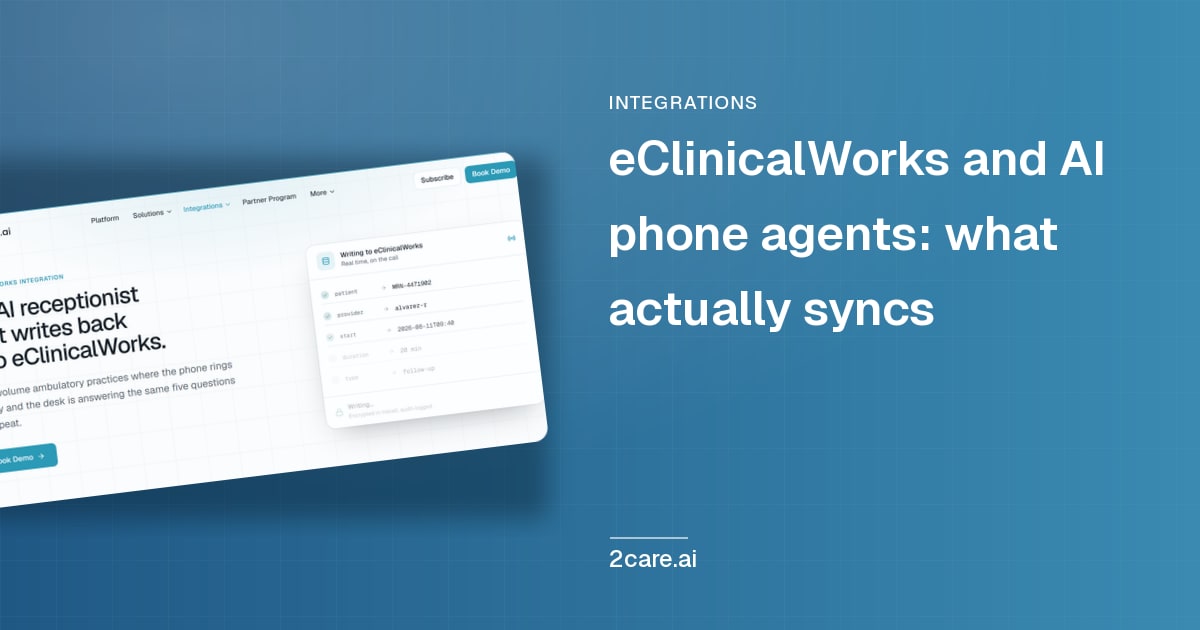
A family physician's walkthrough of what 2care.ai's eClinicalWorks integration actually writes to the chart, and what still needs a human.
In short: 2care.ai's integration with eClinicalWorks lets an AI phone agent read open slots and write new or rescheduled bookings into a practice's existing eCW schedule. It does not touch clinical notes, labs, or the in-basket. Any call that isn't a straightforward booking request routes to the front desk or an on-call clinician.
It's 4:50pm on a Friday. The phone has not stopped since lunch. A mother calls to move her son's Monday physical to Tuesday because of a school conflict. Behind her in the queue, a patient wants to know if Dr. Patel has anything open next week. Behind that, someone is calling back a third time about a form that was supposed to be faxed. None of these calls are urgent. All of them are competing for the same two hands at the front desk, and all three will still be waiting if nobody picks up before 5.
This is the part of family medicine that never makes it into a textbook: the schedule is a clinical tool, not an administrative afterthought. A missed reschedule becomes a no-show. A no-show becomes a gap in a chronic-disease follow-up. The call itself is mundane. What it protects is not.
The scene above is a composite, drawn from patterns across many real calls rather than one patient or practice. What follows is a walkthrough, from the seat that signs off on what an AI agent may touch in a patient's chart, of what connects to eClinicalWorks when a call like that comes in, and what still has to reach a person.
What the eClinicalWorks integration actually connects today
Most of what gets written about EHR integrations describes the sales pitch, not the wiring. So here is the wiring itself, in plain terms, starting with the boundary that matters most: what the agent can see and change, and what it can't.
2care.ai's phone agent connects to eClinicalWorks through the healow Open Access API, the same channel eClinicalWorks built for outside applications to read and write scheduling data without a separate login or a screen-scraping workaround. Two things happen through that channel today. The agent can read a provider's open slots as eCW shows them, and it can write a new appointment or move an existing one. That is the entire surface area. Clinical notes, lab results, medication lists, and the provider in-basket sit outside this integration completely, the same as they would for any other front-desk scheduling tool.
Scale is part of why this channel matters. eClinicalWorks reports more than 180,000 physicians and nurse practitioners running its EHR, with over 850,000 healthcare professionals and 110,000 facilities on the broader platform worldwide. A scheduling integration built against that one channel reaches a large share of the family medicine practices this post is written for, without each practice needing a custom connection of its own.
That narrow scope is a choice, not a current limitation waiting on a later release. A scheduling write and a clinical write are governed differently inside 2care.ai, and widening that surface would need its own sign-off before it shipped, not a software update.
Why real-time scheduling matters more than it used to
A JAMA study of Epic records across more than 2,000 hospitals and 47,000 clinics found patient-written portal messages to clinicians rose 153 percent between 2020 and 2025, from 0.99 to 2.5 messages per patient per year, while office visits rose a comparatively modest 17 percent over the same stretch. Front desks are fielding more contact per patient than they were five years ago, through more channels, which is exactly the condition under which a scheduling call sitting in a queue for a batch sync becomes a scheduling call that gets missed entirely.
The stakes of a missed reschedule are bigger than they look nationally. An AMN Healthcare survey of 15 major metro markets put the average wait for a new-patient family medicine appointment at 23.5 days as of May 2025, against an overall average across specialties of 31 days, itself up 19 percent since 2022. A July 2025 MGMA Stat poll of 269 practice leaders found 66 percent reporting new-patient wait times held steady or shortened year over year, so the trend isn't universal decline, but a practice that loses a slot to an unreturned call is handing it back into a queue that, on average, runs over three weeks long.
How a phone call becomes a confirmed slot in eClinicalWorks
When an H2 is phrased as a question, the short answer goes first: a booking call becomes a confirmed slot by the agent reading the provider's real-time availability from eCW, confirming a time with the caller, and writing that appointment back into the same calendar the front desk already uses, with no nightly import and no second system to reconcile.
The table below shows what happens call type by call type, including what happens when the agent cannot finish the job itself.
| Call type | What the agent does | What lands in eClinicalWorks | If it can't complete |
|---|---|---|---|
| Reschedule an existing visit | Pulls the provider's open slots, confirms a new time with the caller | The existing appointment updates in place | No slot in the caller's stated window: offers the nearest alternative or hands off to the front desk queue |
| New-patient booking | Checks whether the practice and provider are open to new patients before offering times | A new appointment is created against a new or matched patient record | Record looks like a possible duplicate: booking holds until the front desk confirms identity |
| Call during an after-hours block | Answers, asks the questions the practice has pre-approved for triage wording | Non-urgent requests are logged as a note for the next business day's scheduling | Any stated urgency routes immediately to the on-call clinician line, not to a morning callback |
| Caller describes a new symptom | Does not assess or respond to the symptom. Logs what the caller said, in their words | Nothing clinical is written as fact; the note is flagged for a clinician to read | Always routes to a person. This row never resolves inside the agent |
| Billing or insurance question | States plainly that this is outside what it handles | No schedule or billing record is touched | Transfers to billing staff or takes a callback request |
Notice the fourth row. That is the boundary the rest of this post is really about.
Where the call stops being a scheduling question
I spend more of my time on that fourth row than on any other part of this integration, because it's the one place where a wrong design decision would actually hurt someone rather than just annoy them.
The rule we hold the agent to is simple to state and hard to get right in practice: the agent may act on anything that has one correct answer sitting inside the schedule, and it must hand off anything that requires judgment about a person's health. A request for Tuesday instead of Monday has one correct answer. A caller describing chest tightness does not, and the agent is not built to guess at one. It logs the caller's own words, flags the note for a clinician, and routes the call to the on-call line in the same motion. Nobody is asked to wait for a callback to find out whether they should have been routed differently.
We review which call types sit on which side of that line the same way we'd review a new triage protocol for staff: in writing, with a specific person accountable for the decision, before it goes live rather than after a near miss.
What a signed BAA covers, and what it doesn't
A Business Associate Agreement is a contract. It defines what data a vendor can touch, what it must do to protect that data, and what happens if it doesn't. It is not a certification, and no such certification exists for a vendor to hold, however often sales material implies otherwise.
For this integration, the BAA scopes the data to exactly what the integration touches: appointment slots and bookings. It commits 2care.ai to the breach-notification and safeguard obligations the law requires of a business associate. It does not, by itself, make the underlying product safe to use for anything the BAA doesn't cover, which is why the scheduling-only boundary in the first section of this post matters more than the paperwork does. A signed BAA and a narrow, enforced scope are two separate protections, and a practice evaluating any vendor should ask about both, not assume one implies the other.
What changes for a family medicine practice on eClinicalWorks
A practice already running eClinicalWorks or healow doesn't adopt a second scheduling system to get this. The front desk keeps using the same eCW calendar, under the same logins, and the appointments the agent books or moves show up there directly, not in an export that someone has to reconcile at the end of the day.
The part worth naming specifically for a family medicine practice is volume shape, not volume size: a generalist panel produces a high ratio of routine, single-answer scheduling calls (reschedules, new-patient intake, "does Tuesday work") against a comparatively small share of calls that need a clinician's judgment. That ratio is exactly what this integration is built to exploit. It handles the first group inside eCW's own scheduling data, and it treats the second group as an automatic handoff rather than a risk to be managed after the fact.
Where this integration is the right fit today
This is a genuinely good fit for a practice that is already live on eClinicalWorks or healow, since the integration reads and writes against that existing schedule rather than asking anyone to adopt a parallel system. It also fits well where a practice wants appointment changes to land in real time rather than on a nightly batch, since the front desk is working off the same calendar the moment a call ends.
It suits a practice that wants its escalation logic written down and reviewable, not folded into a vendor's general terms of service, because the call-type boundary in this post is the same one we'd hand to an auditor or a new clinical hire. And it fits a practice comfortable operating under a BAA scoped narrowly to scheduling data specifically, rather than a broader grant of chart access it doesn't need for this use case.
Frequently asked questions
Does the integration read or write clinical notes in eClinicalWorks?
No. The integration is scoped to scheduling: it reads open appointment slots and writes new or rescheduled bookings. It does not read, write, or summarize clinical notes, lab results, medications, or the provider in-basket. Those fields stay inside eClinicalWorks, untouched by the phone agent.
What happens if a caller describes an urgent symptom?
The agent does not assess or respond to the symptom itself. It logs what the caller said in their own words and routes the call immediately to the on-call clinician line, the same line the practice already uses after hours. No urgent call waits for a morning callback.
Does this replace the practice's front desk staff?
No. It handles the scheduling calls that have a clear answer: booking, rescheduling, and checking open slots. Anything ambiguous, clinical, or financial still reaches a person, usually the same front desk team, just with fewer routine calls competing for their attention.
Is the scheduling data covered by a Business Associate Agreement?
Yes. The integration operates under a signed BAA that defines the data it can touch, which is limited to scheduling. A BAA is a contract about data handling. It does not certify a product as "HIPAA compliant" in some universal sense, since no such certification exists.
How fast does a booking made by the agent show up in eClinicalWorks?
Bookings and reschedules write directly into the practice's existing eCW schedule rather than syncing on a nightly batch delay. The front desk sees the same appointment in the same calendar it already uses, with no separate import step or reconciliation at day's end.
A practical next step, whether or not you ever call us
Before evaluating any AI phone vendor, pull two weeks of call logs from your practice's phone system and sort them into scheduling, clinical, and billing. That split, not a vendor's demo, is what tells you whether an integration like this one is worth the conversation, and it's a useful exercise even if the answer turns out to be no.
If your practice already runs on eClinicalWorks or healow and wants to see this integration against your own schedule, book a short walkthrough with our clinical operations team. We'll also walk through our clinical escalation framework for anyone who wants the governance model before the demo.
More stories
All posts
Get every new post by email
Notes from the front desk, sent as they publish - every Tuesday and Friday. No filler.
I agree to receive the 2Care AI newsletter. Unsubscribe anytime.