
Practice operations
Medicaid Work Requirements Are About to Ghost Your Patients
Medicaid work requirements start in 2027. See how 2care re-checks coverage, routes 271 rejections and runs renewal calls. Read on.
Key takeaways
- Medicaid work requirements start by 1 January 2027, adding 80 hours a month of activity, 6-month renewals and one month of retroactive coverage.
- A 271 answers only for the date asked, so 2care sweeps hourly and re-checks every visit booked in the next 48 hours before the patient arrives.
- 2care stores each 271 as typed fields, keeping null apart from zero, and reads an unrecognised status as unknown so a covered patient is not turned away.
- AAA codes 72, 73 and 71 go to staff as a field to correct, 75 retries as a dependent, and 42 retries after 15 minutes.
- 2care renewal calls run from the practice's own dates, check the do-not-call list first and honour STOP, inside the robocall rule's limits.
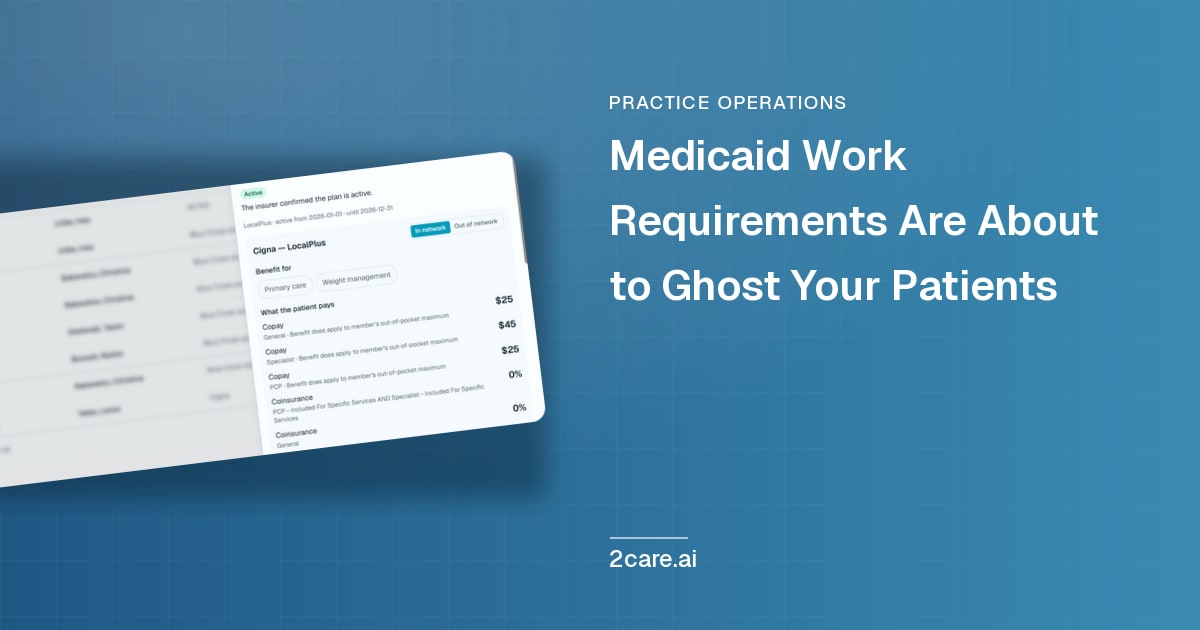
From 1 January 2027, CMS requires states to make 80 hours a month of work, school or community service a condition of Medicaid for expansion adults. These Medicaid work requirements change coverage at renewal, and the standard eligibility check, the X12 271, answers only for the date it is asked about. 2care therefore re-checks every patient booked in the next 48 hours and routes each answer to a fix, a retry or a task before the visit.
The rule reaches the adult expansion group in 43 states and the District of Columbia, according to the CMS fact sheet. A person can also qualify on earnings of $580 a month in 2026, and a person the state cannot verify gets 30 calendar days to respond to a notice. Two companion changes start on the same day: renewals every 6 months for expansion adults, and retroactive coverage cut from three months to one.
- 1 Jun 2026CMS issues the interim final rule on community engagement
- 1 Jan 2027Work requirement, 6-month renewals and one-month retroactive coverage begin
- Mar 2027First renewals decided under the rule fall due in March or April
- 1 Jan 2028A self-attested frailty statement is accepted once per enrollment period
For a practice, each of those changes lands at the front desk as a coverage answer that was true last month and is wrong today. The sections below follow one Medicaid visit through our eligibility pipeline, from the scheduled check to the renewal call.
Our platform re-checks Medicaid within 48 hours because a 271 answers for one date
A 270 inquiry names a date of service, and the 271 answers for that date. The Minnesota Uniform Companion Guide for the 270/271, a state rule, requires payers to answer for a coverage date up to 12 months in the past. The standard has no field that forecasts a renewal, and the work-rule status stays with the state: Georgetown University's Center for Children and Families notes in its explainer of the interim final rule that states may not delegate the compliance decision or the notice to managed care plans.
Timing sets the architecture. CAQH CORE's real-time response rule allows a payer up to 20 seconds per 271, met when 90 percent of a month's responses arrive inside that limit. A wait that long cannot sit inside a phone call, so in 2care the check runs on a schedule and the 2care voice agent never sends one. Insurance a caller reads out is saved as a draft for staff to confirm.
- SweepEvery hour, find the visits booked in the next 48 hours
- QueueOne job per visit, on a queue partitioned by clinic
- WorkerSend the 270 through a clearinghouse connection and wait for the 271
- ClassifyRead the status and any AAA code, then store the answer as typed fields
- RouteActive goes to the visit sheet, a rejection becomes a fix or a retry, inactive is flagged for staff
One job per visit goes onto a queue partitioned by clinic, so a large practice's batch never delays a small one. An answer is reused for up to 7 days, every check counts against a monthly budget the practice sets, and an optional second check runs closer to the appointment, when a March or April renewal decision can still change the answer.
Every 271 field is stored as typed data, and a missing value stays null
The worker turns each 271 into a record with three states for every value: the payer sent a number, the payer sent zero, or the payer sent nothing. A copay the payer left out is stored as null and shown as not returned, so nobody quotes a patient a zero copay the plan never stated.
coverage:     active          // active | inactive | unknown
planStart:    2027-01-01
planEnd:      null            // not sent by the payer
copay:        0               // the payer said zero
deductible:   null            // not returned, never read as 0
otherPayers:  []              // other coverage on file
Status follows the same rule. An unrecognised status code reads as unknown and never as inactive, because a wrong "inactive" turns away a covered patient.
| What the 271 returns | What the platform stores | What happens next |
|---|---|---|
| Active for the visit date | Status, plan dates, cost-sharing fields | Shown on the visit sheet |
| Inactive for the visit date | Status inactive, plan end date if sent | Flagged for staff, with an insurance re-ask text if switched on |
| A field left out | Null, labelled not returned | Never shown as zero |
| AAA 72, 73 or 71 | The field the payer rejected | Staff correct it, then re-check |
| AAA 75 | Subscriber not found | One retry as a dependent, then corrections |
| AAA 42 | Payer unable to respond | Automatic retry after 15 minutes |
AAA codes 72, 73 and 71 become a field fix, while 75 and 42 retry
A 271 that cannot match the member returns an AAA segment with a reason code. The Minnesota guide defines 72 as an invalid or missing subscriber ID, 73 as an invalid or missing subscriber name, and 71 as a date of birth that does not match the payer's record.
AAA*N**72*C

AAA reject code
|-- 72  member ID        -> re-read the card, re-check
|-- 73  subscriber name  -> spelling, second surname
|-- 71  date of birth    -> confirm with the patient
|-- 75  not found        -> one retry as a dependent
|-- 42  payer busy       -> retry after 15 minutes
`-- 43  provider ID      -> one task, payer paused
Code 43 means the payer does not recognise the practice's provider identifier, so the platform opens one task and pauses checks to that payer for the clinic until the NPI or enrolment is fixed. Repeating the request would buy the same refusal.
When a member is not found, staff see up to 3 suggested corrections, ranked: first and last name swapped, a hyphenated or single surname, day and month swapped in the date of birth, or a member ID prefix or suffix. The cap is deliberate, because each extra attempt is another billed check.
Medicaid goes last in payer order, and a staff member applies it
When a patient has Medicaid and another plan, Medicaid pays after any liable third party. Under 42 CFR 433.139, when a third party's liability is known at the time a claim is filed, "the agency must reject the claim and return it to the provider for a determination of the amount of liability."
Our payer-order engine applies rules in layers, with no network calls inside the decision: the order the payer states, then federal rules (Medicaid after liable third parties, Medicare Secondary Payer), then commercial rules. It tells Medicaid fee-for-service from managed care using the 271's insurance type and the plan name. Each result comes back as Confirmed, Likely, Conflict or Needs answers, and only a staff member can apply an order to the record.
The shorter retroactive window raises the cost of a wrong order. The Maryland Department of Health summary of the law lists retroactive coverage falling from three months to one month for expansion adults and two months for everyone else, so a claim rejected and refiled late has less coverage behind it.
Renewal calls run from the practice's dates, inside robocall limits
The 271 cannot see a renewal coming, so the platform works from the practice's own list. The practice loads its patients' renewal dates, and the outbound agent tells each patient that recertification is due by, or lapsed on, that date and gives the renewal phone number, with an optional follow-up text in Spanish. Every campaign call checks the do-not-call list first, texts honour STOP, and calls go out only inside the campaign's calling window.
Those limits track the federal robocall rule. The healthcare exemption at 47 CFR 64.1200(a)(9)(iv) covers a listed set of purposes, from appointment reminders to prescription notifications, and coverage renewal is not on it. The same paragraph bars billing or other financial content and caps exempt messages at one a day and three a week, voice calls at about one minute and texts at 160 characters. A practice running renewal calls needs its own consent basis, confirmed with counsel.
Outreach recovers a share of patients, and the evidence sets the size. KFF's unwinding tracker counts at least 25,198,000 people disenrolled in 2023 to 2024, 69% of them for procedural reasons. A National Bureau of Economic Research working paper by Myerson, Espeseth and Dague, a preprint not yet peer reviewed, found that telling enrollees where to get renewal help raised renewal by 1 percentage point and cut procedural denials by 1.1 percentage points. CMS states that a disenrolled person may reapply at any time, so a lapsed patient leaves the call with the renewal number and a follow-up booked.
Claims filed in 2027 feed the 2028 frailty screen
Medically frail adults are exempt, and the state decides who qualifies from the record. Georgetown's explainer reports that states must use claims, whether paid, pended or denied, together with encounter data from the prior 12 months. Starting 1 January 2028, a state may accept a self-attested statement once during an enrollment period.
The diagnosis codes on a practice's 2027 claims are therefore part of the data a state reads in 2028. Complete coding on each claim is already a billing requirement, and under this rule it also feeds an exemption decision the practice never sees directly.
What a practice needs before it starts
The pipeline works best for a practice with these in place:
- Expansion adults on the schedule: visits billed to Medicaid for adults in the expansion group.
- Payer and member ID on every patient: stored per patient, so each 270 carries the inputs a payer matches on.
- A renewal-date list: an export from the state portal or the managed care plan, loaded for outreach.
- A consent basis for coverage calls: confirmed with counsel before the first renewal call goes out.
Insurance verification is switched on per practice. See insurance verification, proactive outreach and the whole platform.
Frequently asked questions
Does the voice agent check eligibility during the call?
No. A real-time 271 can take up to 20 seconds, so checks run on the hourly sweep and before the visit. During a call the agent records the payer and member ID the caller reads out as a draft, and staff confirm it before the scheduled check uses it.
Does the 30 day notice period change what the 271 says?
No field in the 271 marks an open noncompliance notice. During the notice period the patient keeps the coverage they had, so the 271 keeps reporting the plan as it stands. The change shows up when the state ends coverage, and the re-check closest to the visit is the one that catches it.
What happens when a payer has no electronic eligibility?
The platform routes that payer to staff as a call-to-confirm task. A person phones the payer and records the answer against the visit, and the record shows it was confirmed by phone. No automated system calls a payer on the practice's behalf.
Do Medicaid managed care plans tell us when a member is at risk?
States may not delegate the compliance decision or the noncompliance notice to managed care plans, so a plan has no compliance status to pass on. A plan portal may show a renewal date, and that date is worth exporting into the renewal list for Medicaid work requirements outreach.
Can a patient who loses Medicaid for missing hours get it back quickly?
They can reapply at any time, according to CMS, and the state assesses them again when they do. Reinstatement depends on meeting the look-back period before the new application or qualifying for an exemption, so the practice gives the renewal number and books the follow-up for once coverage is confirmed.
Next step
This week, export the Medicaid expansion adults booked between March and June 2027. For each one, confirm the member ID, the date of birth and the surname exactly as printed on the card, and a mobile number the patient answers. Those are the fields behind codes 72, 73 and 71, and the number is how a renewal reminder reaches them.
See the eligibility pipeline and a renewal call run on your own Medicaid schedule: book a 30-minute demo with the 2care engineering team.
Sources
- Centers for Medicare & Medicaid Services, Medicaid Community Engagement Requirement for Certain Individuals Interim Final Rule with Comment Period (CMS-2454-IFC), 1 June 2026.
- Minnesota Department of Health, Minnesota Uniform Companion Guide v14.0 for the 270/271, effective 4 April 2024.
- Georgetown University Center for Children and Families, An explainer of the interim final rule on Medicaid work reporting requirements, 16 July 2026.
- CAQH CORE, Phase I CORE 156: Eligibility and Benefits Real Time Response Time Rule, March 2011.
- Legal Information Institute, 42 CFR 433.139, Payment of claims, current text.
- Maryland Department of Health, Impact of Congressional Budget on Maryland Medicaid Program, 16 July 2025.
- Legal Information Institute, 47 CFR 64.1200, Delivery restrictions, current text.
- KFF, Medicaid Enrollment and Unwinding Tracker, updated 25 September 2026.
- National Bureau of Economic Research, Navigating Medicaid: Experimental Evidence on Administrative Burden and Coverage Loss, working paper 34191, August 2025.
More stories
All posts

Get every new post by email
Notes from the front desk, sent as they publish - every Tuesday and Friday. No filler.
I agree to receive the 2Care AI newsletter. Unsubscribe anytime.