
athenahealth integration
An AI receptionist that books straight into athenahealth.
Growing ambulatory groups where the front desk is already at capacity and the answer to more volume cannot be more headcount.
Writing to athenahealth
Real time, on the call
Writing…
Encrypted in transit, audit-logged
Who runs athenahealth
athenahealth practices are typically ambulatory groups in growth mode, several providers, often several sites, run lean on purpose. The phone is where growth turns into either revenue or churn.
The problem
What is actually breaking.
The things practices tell us cost them the most, in the order they raise them.
Growth arrives as call volume first
More patients means more calls long before it means more staff. The desk absorbs it until it cannot, and then bookings start leaking.
New-patient calls are the ones you lose
An established patient will ring back. A new patient calls the next practice on their list, and you never know it happened.
Admin work outlives the call
Intake gets retyped, follow-ups get written on a pad, and somebody reconciles it later.
Nobody works the recall list
The patients due back are known. Calling them is the job nobody has time for.
How it connects
Real time
Written while the patient is still on the line. Every write logged and reversible.
How 2care solves it
One platform, not a point fix.
Inbound answering, outbound outreach, write-back and escalation are the same agent - which is why the whole problem moves rather than one part of it.
Capacity that does not need hiring
Volume stops being a staffing question. The same agent covers the 9am spike, lunch and Saturday.
New patients booked on the first call
Answered on the first ring, qualified, and booked, before they get to the next name on their list.
No admin tail
Demographics, insurance and reason for visit land as structured fields, and follow-ups become tasks in the queue your team already works.
Recall runs itself
Outbound works your own lists on your cadence, so the patients due back actually get called.
At a glance
The athenahealth connection, in the terms a review will ask about.
An athenahealth group is usually ambulatory and growing on purpose while kept lean: a few providers spread across one or several sites. Whether that growth turns into income or attrition tends to be settled on the phone.
The difference
What changes on the athenahealth phone.
At this scale the real question is not getting the phone picked up. It is whether picking it up means paying for one more salary.
How it runs today
With 2care on athenahealth
Growth arrives as call volume first
A rising caseload lands as ring volume well before it justifies another hire
Volume stops being a staffing question
New-patient calls are the ones you lose
An established patient will ring back
Picked up straight away, screened and scheduled, before the caller reaches the next clinic on their shortlist
Admin work outlives the call
Someone rekeys the intake, scribbles follow-ups onto a pad, and squares the lot away afterwards
Contact details, cover and the visit reason arrive as clean fields, while each follow-up appears as a task where staff already look
Nobody works the recall list
The patients due back are known
Outbound runs against your own lists at the pace you choose, so people due to return are the ones who get rung
Scope
What it touches in athenahealth.
Read it in three passes. The third is the half a Marketplace listing never covers.
- Department
- Which athenahealth department a caller needs, taken from how they describe the problem.
- Provider template
- Each provider's athenahealth template, including the slots held back for same day.
- Visit type
- Appointment classes, so a new patient and an established review are never confused.
- Patient identity
- Existing patient records, so a returning caller is recognised rather than re-entered.
- Coverage on file
- Insurance already stored, so nobody is asked to repeat what you hold.
Straight answers
What athenahealth practices ask before connecting it.
Will it keep working as we open new sites?
Yes. New locations and providers are picked up from athenahealth rather than configured again, which is the point for a group adding sites faster than it adds front desk staff.
Can it handle our same day slot policy?
It books within whatever athenahealth already enforces. If you hold slots back for same day, the agent can only offer them when your own rules allow it.
What about patients who ring after we close?
They are answered and booked. Around eighty five percent of people will not leave a voicemail, so an evening call left unanswered tends to be a new patient lost outright rather than one merely delayed.
We are not granting broad write access to athenahealth.
Nor should you. Bookings respect each provider's own athenahealth appointment types and slot rules. Clinical documentation sits outside the scope entirely.
Go live
Weeks, not quarters.
Most practices on athenahealth are live inside a few weeks of authorising the connection.
Authorise the connection
Your athenahealth administrator approves API access. Nothing is installed, and nothing changes about how your team uses athenahealth.
Map your rules
We map your providers, locations, appointment types, booking rules and escalation paths - the things that make your schedule yours.
Test, then go live
We run your real scenarios against a test environment with your team watching, fix what surfaces, then switch the line over and monitor.
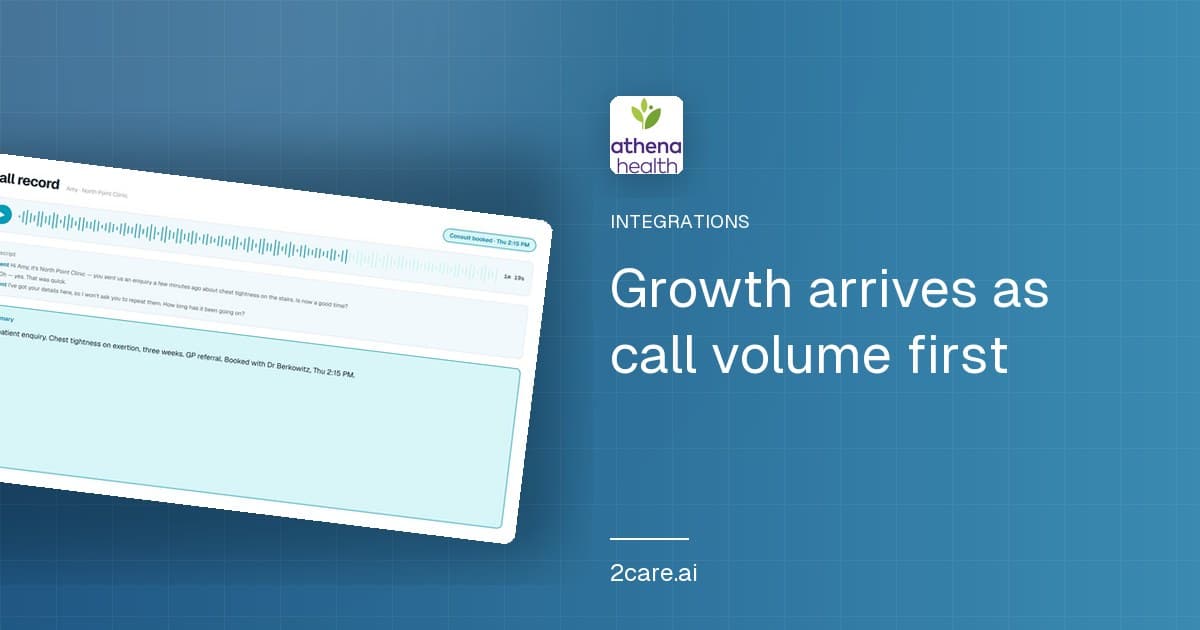
See it work
A call, a booking, and a write-back into athenahealth.
Recorded end to end. The system on screen is not yours, but the flow is the one described above.
Before you connect it
Questions about athenahealth.
That is normally the reason groups sign up. Answering no longer scales with how many people you employ, since the agent absorbs the routine volume while your staff look after whoever is in the building.
They get picked up and scheduled rather than dropped into voicemail. Roughly 85% of people never leave a message, so an evening call that rings out is normally a patient lost.
An AI receptionist for athenahealth is the same thing under a third name. A athenahealth answering service describes covering the phone. A athenahealth integration describes what connects to what. Here they are one product: cover for the line that reads your diary and writes the booking straight into it.
Bookings respect each provider's own athenahealth appointment types and slot rules, confirmed while the caller is still speaking.
No. Callers are matched against what athenahealth already holds before anything new is created.
Yes. Every call is transcribed against the athenahealth record, which matters when a group is auditing why a booking was made.
See 2care book into athenahealth.
30 minutes, on your own call flows. No commitment.
- 18 specialties covered
- ·Live in weeks, not months
- ·HIPAA, GDPR and DPDP