
Epic integration
An AI receptionist for Epic, across every department.
Hospital-owned groups and large multi-specialty practices, where one number fronts dozens of departments and the hold queue forms before 9am.
Writing to Epic
Real time, on the call
Writing…
Encrypted in transit, audit-logged
Who runs Epic
Epic practices are usually large: hospital-owned groups, academic centres and multi-specialty organisations with many departments behind a single published number. The clinicians are not the constraint. Access is.
The problem
What is actually breaking.
The things practices tell us cost them the most, in the order they raise them.
The switchboard is the bottleneck
Hundreds of callers arrive in the same hour and there are only so many people to answer. The queue forms, and a meaningful share of those patients hang up and go elsewhere.
Patients cannot describe the department they need
They describe a symptom. Somebody then has to interpret it and route the call, which is slow and gets it wrong often enough to create a second call.
Referrals and follow-ups sit in queues
The work that has already been approved, referrals, post-op reviews, imaging follow-ups, waits for a person with a spare half hour.
Everything must be auditable
In an organisation this size, anything touching the record has to be logged, reversible and reviewable, or it does not get approved.
How it connects
Real time
Written while the patient is still on the line. Every write logged and reversible.
How 2care solves it
One platform, not a point fix.
Inbound answering, outbound outreach, write-back and escalation are the same agent - which is why the whole problem moves rather than one part of it.
Every caller answered at once
No one waits in a queue, because there is no cap on concurrent calls. Peak hour behaves exactly like 3am.
Routing from what the patient actually says
The agent works out the department and visit type from a symptom description, then books inside that department's rules, or escalates if it is clinical.
The approved work gets worked
Outbound outreach runs your referral, recall and follow-up lists on a schedule you set, so nothing waits for someone to find an hour.
Written back, logged, reversible
Bookings and intake land in the record as structured data, every action is audit-logged, and nothing the agent does is irreversible.
At a glance
The integration, in the terms your review will ask about.
Everything below is settled during implementation review rather than assumed. If a row here does not match what your organisation will approve, that is worth finding out on the first call.
Scope
What it touches, object by object.
The third group is the one worth reading. Most vendors publish the first two and leave the boundary to be discovered during implementation.
- Department / service
- To resolve which service a caller needs from how they describe the problem.
- Provider schedule
- Working hours, existing bookings and blocks, checked at the moment of the call.
- Visit type
- So a new patient assessment and a review are booked at their correct lengths.
- Patient identity
- Enough to match a caller to an existing record and avoid creating a duplicate.
- Coverage on file
- To confirm what is already held rather than asking the patient to repeat it.
Clinical escalation is a routing decision, not a clinical one. The presentations that must reach a person are defined by your organisation in its own wording, and the same rules run on every call regardless of the hour.
The difference
Sitting beside Epic and writing into it are different products.
Most voice AI in this category ends the call by handing your team something to do. At this volume that has moved the work rather than removed it.
Voice AI that sits beside Epic
2care
Availability
Read from a synced copy, minutes or hours old
Read live, at the moment of the call
The booking
A request queued for staff to key in
Written into Epic during the conversation
Peak hour
A queue forms and callers abandon
Every caller answered at the same time
Department routing
A menu the patient must decode
Resolved from how they describe the problem
Your morning
Reconciling yesterday against the schedule
Nothing to reconcile
Audit
Depends what the tool chose to log
Every call and every write recorded and reversible
Straight answers
What the review board raises.
We are not granting broad write access to the chart.
Nor should you. Scope is limited to scheduling and the demographic fields needed to book, agreed during implementation review. Clinical documentation is out of scope and the integration cannot reach past the permissions you configure.
What happens when it gets something wrong?
Every write is a discrete, attributable event that can be reversed, and every call is transcribed. The failure mode is a booking you can trace and undo, rather than a change nobody can account for afterwards.
Our departments each have their own scheduling rules.
Which is why the rules are read rather than reproduced. Providers, visit types and constraints come from each department's own configuration, so the agent can only offer what that service already permits.
How is this different from our patient portal?
It is the same job for the people who telephone instead. Self-service covers the patients who will use it, and the phone is what the rest use, including most of those who ring in the first hour of the morning.
Go live
Weeks, not quarters.
Most practices on Epic are live inside a few weeks of authorising the connection.
Authorise the connection
Your Epic administrator approves API access. Nothing is installed, and nothing changes about how your team uses Epic.
Map your rules
We map your providers, locations, appointment types, booking rules and escalation paths - the things that make your schedule yours.
Test, then go live
We run your real scenarios against a test environment with your team watching, fix what surfaces, then switch the line over and monitor.
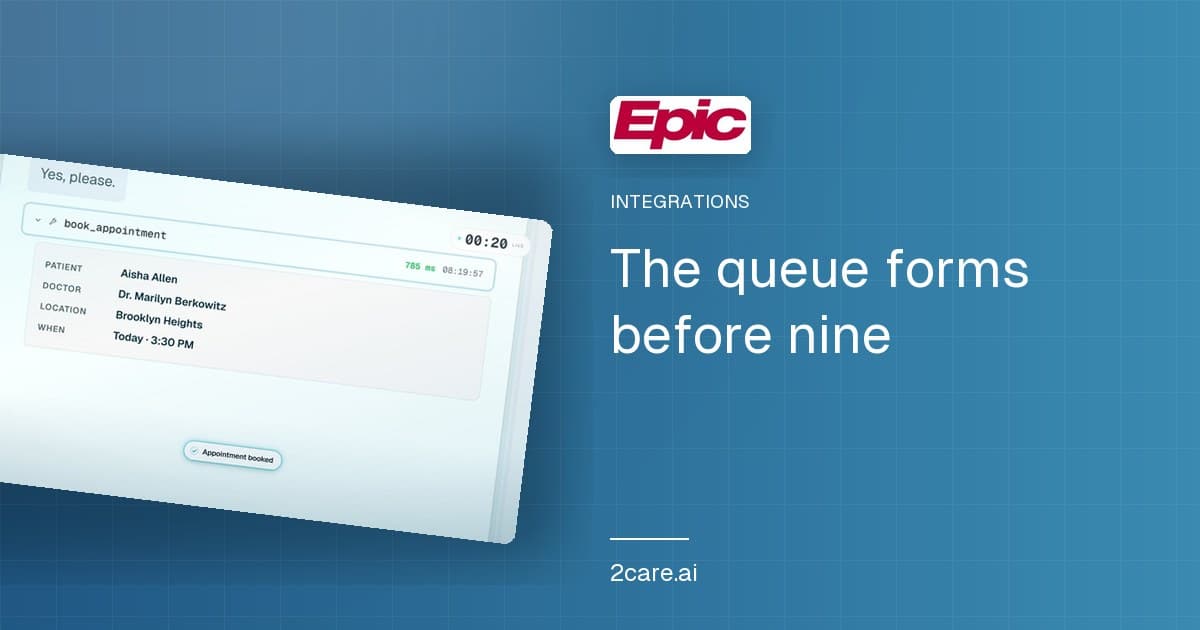
See it work
A call, a booking, and a write-back into Epic.
Recorded end to end. The system on screen is not yours, but the flow is the one described above.
Before IT asks
The questions an Epic organisation asks.
Through Epic's supported integration route, authorised by your organisation and scoped to what the agent needs to read and write. The specific scopes are agreed during implementation review rather than assumed, and nothing is installed on your estate.
Both terms get used for it. Organisations search for an Epic answering service when they are covering a phone, and for an Epic integration when they are assessing what connects to what. It is one product: cover for the published number that can also book.
It writes. Availability is read live and the appointment is created during the call, which is the distinction that matters at this volume. A tool that returns a queue of booking requests has moved the work rather than removed it.
It reads departmental availability, provider schedules and visit types, plus enough of the record to identify a caller. It writes appointments and the demographic and coverage fields captured on the call. It does not write clinical documentation.
That is precisely what it was built to do. Department and visit type are worked out from the way the patient frames the problem rather than from a menu, then the booking is made within that department's own rules.
There is no limit on concurrency, so the nine o'clock peak is answered at the same speed as an overnight call. Queue abandonment at peak is usually the largest single loss a health system can measure here.
Yes. Each call is transcribed and stored, each write is kept as a reversible event carrying its source, and every escalation notes what went up and the reason. HIPAA-ready, with a BAA signed before any patient data moves.
It is escalated on the protocol your organisation defines, with the call detail attached. The agent does not assess symptoms, discuss results or advise on medication under any circumstances.
Longer than a small practice and still weeks rather than quarters. Most of the time goes on the review itself: agreeing scopes, escalation rules and department mapping, then testing against your own scenarios before any line moves across.
See 2care book into Epic.
30 minutes, on your own call flows. No commitment.
- 18 specialties covered
- ·Live in weeks, not months
- ·HIPAA, GDPR and DPDP